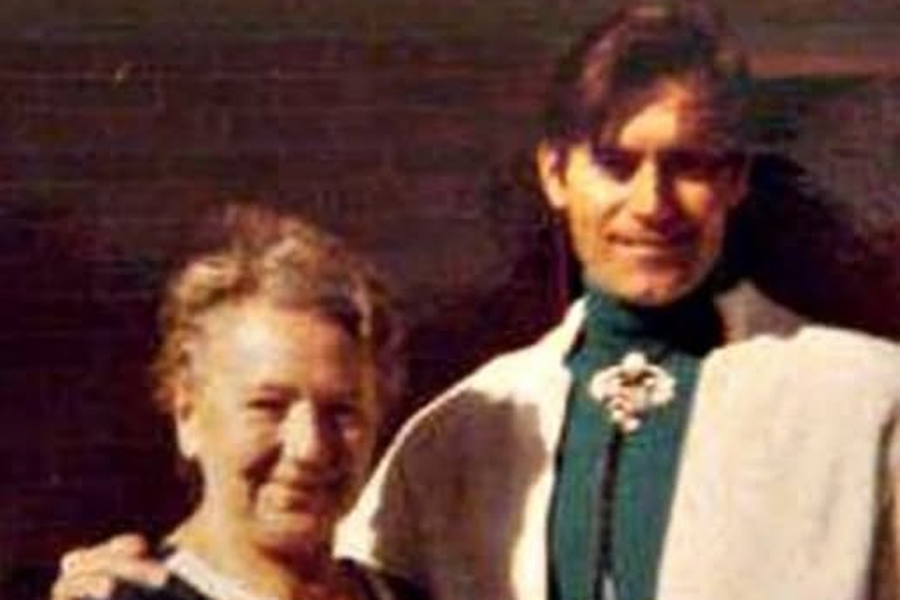
A life that held the frame together
Gladys Huldah Walker belongs to the kind of history that rarely arrives with a trumpet. Her name does not ride on headlines or credits. It rests in the background, in the places where family begins and takes root. Yet that is exactly why her story matters. The people who live outside the spotlight often shape the strongest beams in a family’s structure. They make the house stand while others step into the light.
Gladys Huldah Walker was born Gladys Huldah Schwanda in 1903, a year that sits at the edge of a century still moving by horse and rail. Her life began in a world that was old in one way and newly restless in another. Migration, settlement, and reinvention were already changing family stories across continents. That larger movement runs quietly beneath her own. She became part of an American household, built a family in Illinois, and left behind a legacy that can be traced through her children and grandchildren. Her life was not a public performance. It was a lived foundation.
The power of her story lies in that restraint. Not every life needs a stage to have consequence. Some lives work like roots, hidden from view but essential to the growth above ground. Gladys Huldah Walker appears to have been one of those lives.
A family shaped by movement and memory
The Schwanda name places Gladys inside a family line that reaches beyond the Midwest. Her father was Thomas Schwanda, and her mother is recorded with some variation in surviving family memory, a reminder that the past is often preserved unevenly. Families carry facts the way they carry photographs, folded letters, and recipes. Some details stay sharp. Others blur at the edges. What remains is the shape of belonging.
That sense of layered identity gives Gladys’s early life a particular texture. A Central European beginning, an American future, and a household that bridged those worlds through marriage and children. The journey from one place to another is never only geographic. It also changes language, habits, expectations, and the daily rhythm of life. In many immigrant families, the older world survives in small things, in the food on the table, in the way names are spoken, in the quiet discipline of thrift and endurance.
Gladys became part of the Walker family through marriage to Paul Arnold Walker. Together, they formed the center of a home that would eventually be remembered because of the children it raised. Marriage in that era was not simply a private bond. It was often an economic partnership, a household structure, and a map for future generations. For Gladys, it seems to have been all of those things at once.
Motherhood in the middle decades
In 1927, Gladys became the mother of twins, Norman Eugene Walker and Neoma Lucille Walker. Norman would later become known to the public as Clint Walker. Lucy, as Neoma Lucille came to be known, remained part of the family story in a quieter register, but no less meaningfully. Twin birth always carries a special kind of gravity. Two children arrive together, linked from their first breath, and the household around them adjusts to a doubled rhythm of care.
Raising twins in the late 1920s and 1930s meant demanding work. There were no easy shortcuts, no soft machinery to handle the endless repetition of domestic life. A mother’s day could be built from laundry, meals, illness, weather, school concerns, and the constant arithmetic of family needs. The labor was intimate and relentless. It left little record, which is exactly why it can be overlooked by history. But a life spent tending to children is not a small thing. It is one of the great invisible arts.
Gladys Huldah Walker lived through a period when America was being reshaped by hardship and change. The Great Depression, war years, and postwar shifts all pressed against ordinary households. Families like hers learned to adapt by necessity. They stretched what they had. They kept moving. They made continuity out of uncertainty. In that sense, her life was part of the deeper fabric of the twentieth century, even if no public archive announced it loudly.
The sister, the son, and the wider circle
A family is never only one famous figure. It is a cluster of lives, each with its own weather. Clint Walker’s rise brought attention to the Walker name, but Gladys’s daughter Lucy also belongs in the center of the story. Twinhood creates an intimacy that begins before memory. Two children who share a birthday, a home, and a mother also share the early architecture of attention. Their relationship would have carried its own private language, visible only from the inside.
Lucy Walker Westbrook’s life adds another layer to Gladys’s legacy. It reminds us that family histories are not built by celebrity alone. They are shaped by the people who teach, paint, work, marry, and hold the line from one generation to the next. Every family has its visible peak and its quieter ridges. The quieter ridges matter.
Gladys’s granddaughter Valerie Walker extends that line into another era, one defined by different ambitions and different forms of professional life. Through her descendants, Gladys’s story moves forward without needing to become public property. It simply continues. That continuation is its own form of permanence.
What a private life can reveal
It is tempting to measure importance by visibility. That habit can flatten history. Gladys Huldah Walker offers a different lesson. Her significance is not tied to office, achievement, or public applause. It rests in the ordinary but decisive work of sustaining a family across decades. That kind of life is easy to miss because it is so familiar. Yet familiar things are often the things that hold the most weight.
Think of a house in winter. The windows may catch the light, but the rafters carry the load. A life like Gladys’s is one of those rafters. It does not demand admiration. It makes admiration possible for others. Her son’s later fame did not appear in a vacuum. It emerged from a household, from discipline, from care, from a mother who was there at the beginning of his story and at the beginning of his twin sister’s story too.
Her own identity also reflects a broader pattern in American history. Many women of her generation are remembered mainly through family connections, even when their actual lives were richer and more complex than the record suggests. They were daughters, wives, mothers, keepers of homes, and guardians of continuity. Their names survive in registers and family trees, but their influence reaches far beyond the paper trail.
Gladys Huldah Walker stands in that lineage. She is not simply a parent to a famous man. She is a figure through whom migration, family formation, and generational change can be seen more clearly. Her life links Central Europe to Illinois, the early twentieth century to the television age, and private labor to public memory. That is not a minor arc. It is a long thread, carefully woven.
The shape of remembrance
When a life like Gladys Huldah Walker’s is revisited, the aim is not to inflate it into something it was not. The aim is to see it more fully. To notice the grain in the wood. To recognize that history is made not only by the people who stand at podiums or on screens, but also by those who build the rooms where the next generation learns how to live.
Her story has the stillness of a family photograph and the depth of a long road. It holds immigration, marriage, motherhood, and the passing of names from one generation to another. It also holds the quiet truth that many of the most important lives are the least publicly documented. They move like water beneath the surface, shaping the land without announcing themselves.
Gladys Huldah Walker remains part of American memory because her family became part of it. But her own life deserves attention on its own terms. She was a mother, a daughter, a wife, and a link in a chain of endurance that crossed borders and decades. Her legacy lives in the people who followed her, and in the quiet power of a life that helped make that following possible.
First Grade Writing Adventures That Turn Ideas Into Words
The Smart Womens Wardrobe That Works Overtime
How To Turn A Sports Room Into A Personal Hall Of Fame